Macmillan Meets Mahmood Noman: A Career Without Borders
Mon, September 07, 2026
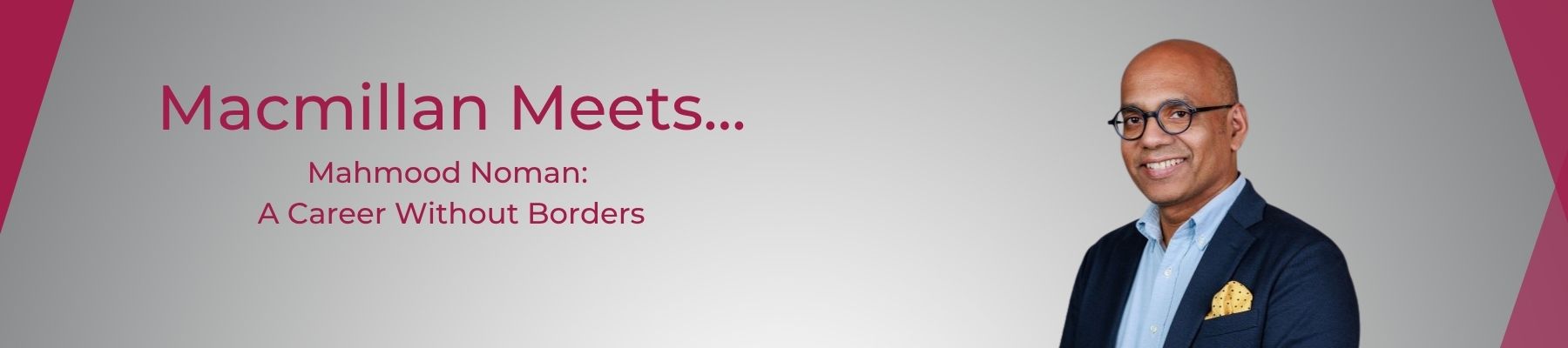
Mahmood Noman has built a truly international HR career spanning almost four decades and working across 38 countries. From starting his career as a Clerk with the British Council to senior People leadership roles across international development, education and the not-for-profit sector, his career has taken him around the world – and most recently to one of its more remote corners.
Now Head of People for the Government of St Helena, Mahmood joins us for Macmillan Meets to talk about his career without borders, what working across different countries and cultures has taught him about people and leadership, and why more UK HR professionals should consider the unique opportunities that an international career – including roles within the UK Overseas Territories – can offer.
St Helena – the latest chapter
Firstly, congratulations on being appointed Head of People for the Government of St Helena! How are you feeling about it?
I’m genuinely delighted. St Helena is a unique place with a strong island community, and the Saints have been wonderfully welcoming to me.
Of all the places your career has taken you, how did the opportunity in St Helena come about? Was working in a UK Overseas Territory something you'd previously considered, or was this an opportunity that simply caught your imagination?
I first saw the role advertised on PM Jobs. After several years based in the UK, I was ready for a new chapter.
I hadn’t specifically set out to work in a UK Overseas Territory, but the fit made sense. These roles draw naturally on UK and CIPD standards while offering a very different context.
You arrived initially as Senior HR Manager, stepped up to Acting Head of HR & OD and have now secured the permanent Head of People role. What have those first few months taught you about the organisation – and what would you ultimately like to achieve?
Every day is a school day. St Helena Government is complex, and I’m still learning how it works. The island faces real workforce challenges, including an ageing and shrinking workforce, retention pressures and the difficulty of attracting skilled people to such a remote place.
I’ve developed the People Strategy 2026–31, and with colleagues across the leadership team, we are focused on helping make St Helena a great place to live, learn, work, visit and invest.
The Strategy acts as the roadmap for aligning all public service employees with our mission, values and strategic priorities. At an operational level, I really want to see an enabling policy environment, improved public service pay, a strong talent pool, clear career pathways and succession plans, and better employment opportunities for Saints.
Ultimately, I’d also like to see a reduced dependency on expensive foreign hires like me!
For those of us sitting in London, what is life actually like on St Helena – both professionally and personally?
Professionally, it is rewarding, though sometimes frustrating. Like many roles in government, progress can feel like two steps forward and one back. Even so, we have made encouraging progress in recent months.
Personally, moving from a city of around nine million people to an island of only around 4,000 inhabitants is a revelation. It’s a profound study in contrasts. Also, everybody knows you here, which really does take some getting used to!
Where it all started
If we go right back to the beginning, you joined the British Council as a Clerk in 1988. Did you have any idea then where your career might take you?
No, but I knew it was an organisation that supported talent and development, with real opportunities to grow. I stayed for 21 years.
Looking ahead, I collect my British Council pension from 2029!
When did HR and developing people become something you realised you were genuinely passionate about?
It began when I was managing larger teams in the 1990s. I found myself increasingly drawn to the people side of the work, more than programme management, so I went on to study a Master’s in Training and Human Resource Management at Leicester University.
Was there a moment when you consciously decided you wanted an international career, or did one opportunity simply lead to another?
There was.
In 1990, I joined the Personnel Section at the British Council as an Overseas Services Assistant in the global mobility team. That was when my interest in a career overseas really peaked.
I had daily contact with our expatriate colleagues across the globe. They had such exciting working lives in places you thought only existed in books – or that I’d never even heard of.
When you work for an organisation present in 110 countries and 225 cities, and engage with international colleagues almost daily, it naturally shapes your outlook. The British Council gave me a platform to learn, develop and grow, and I remain very grateful for that.
A career without borders
You've now had professional experience across 38 Commonwealth and non-Commonwealth countries. Which country or assignment has had the biggest impact on you personally, and why?
Bangladesh.
It was my first expatriate role and it’s also where my parents were from. I felt very privileged to learn more about the place, its people, the culture and the language.
But there was another very personal aspect to it.
I lost my father to cancer less than six months before I left for Bangladesh. I never got the chance to tell him that I was going. I could have learned so much from him about our family history before I left.
He came to Britain as an economic migrant in the 1960s, and he would have been so proud.
You've actually lived and worked for extended periods in places including Bangladesh, Ghana and Malaysia. What do you learn from immersing yourself in another culture that you simply can't learn from a short international assignment?
Cultural immersion forces you to co-exist and unlocks a different layer of psychological insight.
You learn a lot about yourself: your assumptions, blind spots and limits. Living in another culture asks you to listen more carefully, adapt more thoughtfully and understand people at a deeper level.
Were there ever any moments when you arrived somewhere and thought, "What on earth have I got myself into?"
Absolutely.
Personal security can be challenging. In Bangladesh, I had to remain in my office during crossfire on the Dhaka University campus on quite a few occasions.
Arriving in Sierra Leone after dark and crossing the bay to Freetown was also a very difficult and traumatic experience. Curfews in Somaliland limited what I could explore but helped manage acute security incidents – and kept you alive!
In Kyiv, the risk from Russian drone attacks has been a very real challenge and continues to be for former colleagues living and working there.
You've worked in some genuinely challenging environments. What has been the toughest situation you've faced internationally, and what did it teach you?
The hardest moments have involved colleagues being directly harmed, including one who was kidnapped in Europe and two others who were killed in terrorist attacks in Asia and Africa.
Experiences like that stay with you.
They taught me the importance of resilience, perspective and remembering that tomorrow is not promised to anyone.
Has working across so many different cultures fundamentally changed the way you approach HR and leadership?
Yes. Whilst we pray at the altar of Josh Bersin, Brené Brown, Adam Grant, Dave Ulrich et al in the West, there is so much to learn from others in far-flung places.
HR practice is shaped by context: government, industry, communities and culture all matter. Working globally has reminded me to stay curious, to listen first and to keep learning from colleagues wherever I am.
What mistakes do you see HR professionals or organisations make when they assume that something which works in the UK will automatically work elsewhere?
We often assume that we are all the same. We are not.
As HR professionals, you need to adapt, reset your assumptions, be present, observe, listen and then speak.
In a new location, intercultural competence matters just as much as technical knowledge.
HR and leadership
Looking through your career, change and transformation seem to be recurring themes – restructuring, organisational design, leadership development, workforce planning and building HR capability. What is it about change that you enjoy?
I enjoy the sense of renewal and the focus on what could be better.
Change is forward-looking, and when it is done well, it can help people and organisations move with more confidence into the future.
You've worked for organisations including the British Council, Commonwealth Secretariat, WorldFish, Gatsby Africa, Saferworld, Chemonics and IIED. Many have a strong international or social purpose. How important has purpose been in the career decisions you've made?
Purpose and service have always mattered a great deal to me.
I feel very fortunate to have had opportunities, particularly in international development with purpose-led organisations. For me, meaningful work is the confluence of purpose and service; it’s working in a way that contributes to something beyond yourself.
HR has changed enormously since you started your career. What do you think HR does significantly better today – and is there anything we've lost along the way?
HR is more professional, data-informed and efficient than when I started. But I do think we have lost some of the human contact along the way.
When I joined the Personnel Section at the British Council, the Director personally briefed me on my responsibilities. Today, many processes are faster and more automated. DocuSign, automated ticketing systems and chatbot triage seem to have replaced some of those spontaneous, face-to-face human conversations.
I still value the simple conversations that build trust and connection.
The person behind the career
An international career sounds incredibly exciting from the outside, but what are some of the sacrifices or downsides that people perhaps don't appreciate?
You miss family events and time with friends.
I missed the birth of my first son because of flight delays. It can also be hard for accompanying family members to settle without their usual support networks.
In Penang, my family found it difficult to settle, so I cut the tour short and returned to London.
You've repeatedly put yourself into unfamiliar environments throughout your career. Are you naturally someone who enjoys being outside your comfort zone?
Yes. I think it comes from curiosity and a genuine interest in people and places.
It helps you grow and keeps you open-minded. It won’t be for everyone, but if you are curious about people and cultures and you have the chance to live and work abroad, I would strongly encourage you to consider it.
Looking back and looking forward
If you could go back and speak to Mahmood the Clerk starting at the British Council in 1988, what advice would you give him?
Don’t let perfect get in the way of good.
Through my educational years, I often spent too long perfecting something before submitting it. I’ve since learned – painfully at times – that you can always improve something.
As I progressed through my working life, I learnt to scale back on including every last detail during the ideas, proof-of-concept and minimum viable product stages. Sometimes it is more important to get something out there – and quickly – knowing you can continue to improve it.
One of the reasons you wanted to share your story was to make other UK HR professionals aware that opportunities like St Helena do come up – whether that's St Helena, Ascension Island, the Falkland Islands or other UK Overseas Territories. What makes these roles so unique, who do you think they're particularly suited to, and what would you say to an HR professional who likes the idea but has never seriously considered taking their career overseas?
These roles are unique because the British Overseas Territories sit within the UK’s sovereignty and formal jurisdiction, so UK HR knowledge and experience can be highly relevant. But the context is different, and that is what makes the work so interesting.
They suit people who are curious, adaptable and resilient.
If you have the chance to work overseas and it feels right for you, I would say give it serious consideration.
Quick Fire
Tea or coffee?
Tea.
Early bird or night owl?
Night owl.
City break or beach holiday?
City break.
Favourite place in the world?
Birmingham. You can take the boy out of Brum, but you can’t take Brum out of the boy!
Favourite music or artist?
Music from the 80s.
Favourite book – or a book you'd recommend?
Journey to the Centre of the Earth by Jules Verne.
You're a motorsport fan – Formula 1 or something else?
All forms – the 24 Hours of Le Mans, Indianapolis 500, Pikes Peak International Hill Climb and others.
If you could have dinner with any three people, living or dead, who would they be?
My parents and Marcus Aurelius.
What's something about you that people who know you professionally would probably be surprised to discover?
That I am a half-decent pool/8-ball player!
And finally – when you're not thinking about work, what makes you happiest?
Long road trips.
Get in touch
If you would like to discuss this article, be featured in a future Macmillan Meets interview, or talk about your search for work or recruitment needs, please contact Simon Cutner directly at scutner@mdhr.co.uk or connect with her on LinkedIn.