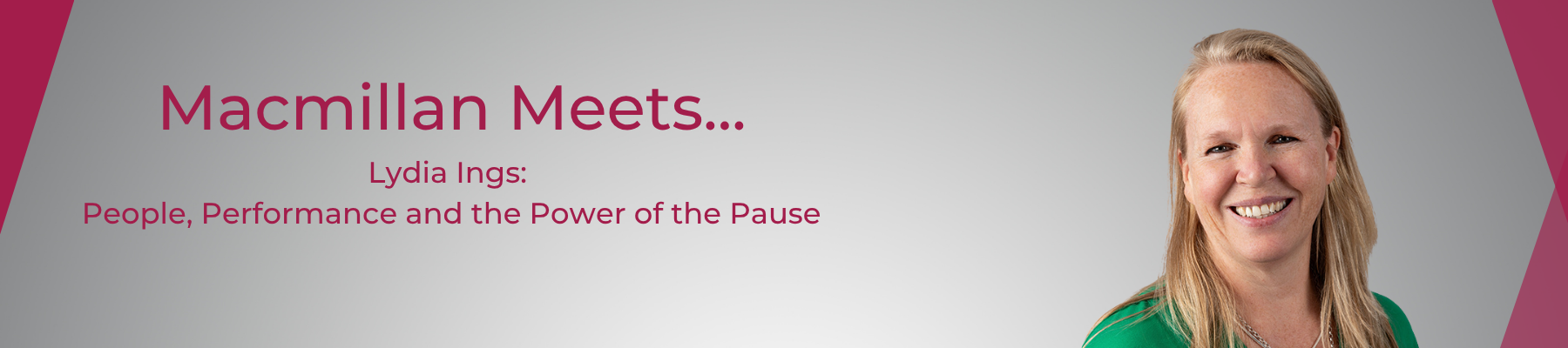
Macmillan Meets Lydia Ings: People, Performance and the Power of the Pause
Tue, September 01, 2026
With more than 25 years in HR and people leadership, Lydia Ings has built a career around developing talent, shaping culture and helping organisations balance the needs of their people with commercial performance.
In this edition of Macmillan Meets, we talk to Lydia about her career journey and leadership philosophy, as well as some of the big questions occupying her thinking today – from our tendency to rush towards solutions in times of change, to AI and the evolving relationship between employer and employee. At the heart of it all is a simple question: in a world that demands ever-faster responses, should we sometimes get better at pausing first?
Lydia, you've spent more than 25 years working in HR and people. Where did it all begin – and was HR actually the plan?
Funnily enough, when I was thinking about this question, I realised that maybe HR wasn't the original plan!
I did a fairly generic degree in Business Administration and Management alongside French Language and Literature. It was around the time of the European Single Market and there was a lot of talk about how combining business with a language was going to be your ticket to all sorts of opportunities. I thought perhaps I'd become a translator or linguist.
After university, though, I worked for a training company and that's really where HR started for me. It was quite niche – specifically report-writing training – but that's where I learnt to design and deliver training.
So training, talent and development became my roots in HR, and I think that has given me a slightly different lens throughout my career.
You hear a lot about the war for talent and how competitive the marketplace is. Of course money is important and you've got to get those basics right, but we know that money isn't always what keeps someone in an organisation. Culture, recognition, how it feels to work somewhere, the quality of the work and the opportunity to develop all matter.
Coming from a talent and development background means I've probably always looked at things with that in mind.
Was the global financial crisis a pivotal moment in your career?
Absolutely.
I went from focusing on training, promotions and career development to, literally overnight, going to close an office and running a group redundancy consultation. It was a real switch.
I was relatively senior by that point, so there was an expectation that I could go in and deal with those situations, but I hadn't actually had a huge amount of experience of redundancies.
I think that experience really shaped my ethos about how I wanted to deliver difficult messages.
I've always felt that having difficult conversations with dignity is really important. Whatever the message, it needs to be delivered with the employee experience at the forefront.
Industries can be small and people remember how they've been treated. Even when it's a difficult conversation, you want people to leave well as well as join well.
One of my favourite quotes is from Maya Angelou. I'm paraphrasing slightly, but it's essentially that people may forget what you said and what you did, but they'll never forget how you made them feel.
That's always resonated with me.
After all these years, do you still get the same satisfaction from seeing people develop?
Without a shadow of a doubt.
I take huge amounts of pleasure in seeing somebody find their groove – finding what they love and are passionate about – and helping them achieve their potential.
If anything, at this point in my career it's even more satisfying, because if any of my own experiences can help somebody else, then that's the icing on the cake.
If you take it back to why we get into HR in the first place, as a people leader there are lots of different things you're dealing with, but fundamentally it is about people and helping them to be their best. Ultimately, that means the business performs at its best too.
One of my other favourite sayings is: it's all about the people.
I've spent the majority of my career in professional services, where relationships are essentially the product, so perhaps that makes it particularly important. But seeing people develop is still one of the best parts of the job for me.
You've seen Personnel become HR, then People and increasingly People & Culture. What actually changes an HR function?
When I came into HR, it was called Personnel. Then it became HR. Then teams became People teams and now quite a lot are People & Culture or People Experience teams.
But labelling something differently doesn't change what is done unless that change is made with intention.
For me, the shift starts with the business and the relationship that HR has with the business – both the leadership and the employees.
I've always said to people in my teams: don't go out and talk to them about people first. Go out and talk to them about their business.
What are they trying to achieve? Who are their clients? What are their challenges? What are they dealing with?
If we understand that, then the people team can really start to add value because the question we're trying to answer becomes much clearer.
I remember someone saying to me once, "But I don't know what to talk to them about."
I said: "Just ask them questions about their business."
Once you do that, you start working alongside people rather than simply providing a service to them. It becomes a proper conversation and a genuine partnership.
And what does being genuinely commercial in HR mean to you?
In a true partnering relationship, the relationship should be balanced. No one voice is more important than another.
The people partner needs to be properly embedded in the business they're supporting. They need to understand what that business is doing and be part of the conversation.
For me, HR professionals are commercial business people who have a specialism in people.
That means approaching business challenges with commercial acumen rather than looking at everything through a people lens alone.
Take something like promotions. HR might be responsible for running the promotions process, and it's very easy to look at it and think how positive it is that lots of people are progressing in their careers.
And of course it is.
But promotion also brings additional fixed cost to the business. You have to consider the organisational structure, affordability and the wider commercial picture.
That's the difference. You're still bringing the people perspective, but you're considering the business as a whole.
How important is it for HR to have a genuine voice at the top table?
For me, it's vital.
The world of work has changed enormously and continues to change, particularly with the increasingly competitive fight for talent.
If people aren't represented at the table, decisions can be made without thinking about that full picture.
The people function needs to be there at the beginning of a decision or a plan – not brought in at the last minute when decisions have already been made and may be very difficult to undo.
But HR also has to earn that position.
We come back to being commercial business leaders. You need that broader perspective. Whether you're talking about clients, finance, brand, M&A or anything else, you have to look at it from a business perspective and not only through the people lens.
That's how you demonstrate that you're adding value.
You've said you're also quite prepared to "get your hands dirty". Is that important to you as a leader?
Very.
It's not only about leadership; it's also because when you're a leader, you need to know what things actually feel like.
If you get too far away from the day-to-day, you don't always know what's working.
There have been times when I've dived into a shared HR inbox to help the team out. When you do that, you suddenly get closer to the employee experience again. You start noticing things and asking, "Why do we do it like this?"
In the days of paper filing, I'd sometimes spend a Friday afternoon filing papers when the wider team needed help.
I'm not suggesting a leader should spend all their time doing that, but every now and again it's important to get a feel for what's happening on the ground.
You learn a lot from it and I also think it sets a good example about the type of team and culture you're trying to create.
You've been thinking about an idea you originally called "Rush forward...row back". What does that mean?
It's really about the power of the pause.
It's about not rushing into something that then becomes very difficult to undo or change.
In this competitive world, there's a real tendency to rush in because people feel like they have to hold on to their edge. There's that feeling of, "Everybody else is doing this, so we'd better do it too."
But sometimes you can find that you've made a bit of a rod for your own back and it's then very difficult to row back.
For me, it's about thinking about the problem we're actually trying to solve first, so that we can plan the response in a way that's sustainable.
Sometimes it's simply about holding your nerve, not rushing in and taking a beat.
That's difficult because of the pace of life, the pace of change and the pace of competition. We're always trying to keep up.
If I don't do this, is somebody else going to come along and take my space in the market?
That's why taking a pause can feel unnatural – and sometimes even risky.
But we need to think about what's right for our clients, our business and our people, because no two organisations are in exactly the same place.
Is hybrid working a good example of what you mean?
I think it is.
After the pandemic there was so much discussion about the way we were going to work. People changed their lives. They moved further away, they got dogs, they developed new responsibilities.
Companies took smaller office spaces and introduced hot-desking. Candidates wouldn't even consider jobs unless they offered two or three days working from home.
Everyone adjusted.
Then companies started saying, "Actually, we want people to come back in because collaboration is better and we're missing those water-cooler moments."
Suddenly, some organisations didn't have enough office space for everyone to come back and get a desk. Meanwhile, employees had made decisions around childcare, pet care, commuting and where they lived based upon the previous arrangements.
If we had that time again, perhaps we wouldn't have rushed quite so quickly to the 3:2 model that a lot of organisations adopted, because in some ways that's become anything but flexible – it can actually feel quite rigid.
Maybe we would have had more open conversations with employees and said: "Can we explore this? We don't know how this is going to work."
Of course, that's easy to say with hindsight and it's much harder in a big organisation where people need clarity.
But I think the learning is about finding that balance and recognising when we're making decisions in circumstances that are still evolving.
You're currently studying AI. Why did you decide to go beyond simply reading about it?
Everywhere you look, everybody is talking about AI. It's all over your social media feeds and emails, and suddenly it's this enormous topic.
I wanted to understand what it actually was so that I could properly work out how it could help me and what I do.
Interestingly, I actually used AI to help me decide which AI course I should take!
Having the opportunity to properly learn about it has been really useful. Some of it is quite technical, but it's been fascinating to understand the basics and also to realise that AI has actually been around for decades. It's not all that new – what's changed is how significantly it has developed in recent years.
For me, it came back to that same principle: I wanted to take a pause and understand what it is and how it can help.
Are organisations in danger of asking "How can we use AI?" before asking what they actually need it to do?
I think there is a danger of that.
The topic is everywhere. Suddenly your feed is filled with AI and HR – use this tool, do this course, try that platform – and that can create a sense of overwhelm and panic.
There's a risk that everything becomes a bit scattergun.
At the same time, organisations do need to be agile and people experimenting with AI can be really useful. At an individual level, that "have a play and see how you get on" approach can help people understand what's possible.
But that can't exist in isolation from a strategic approach.
There needs to be some thought about what are the problems we're trying to solve, and can AI help us solve them?
Simply giving everybody access to an AI tool and saying "have a go" isn't a strategy on its own.
As with most things, it's about finding the balance.
Has studying AI changed how you think about its impact on HR and the workplace?
One of the things I've learnt is that there's still a human element in AI, and perhaps we don't need to be quite so scared of it.
AI will definitely change the way we work, but I don't believe it will replace all human interactions. There will be a new balance.
From an HR perspective, I can see huge potential around workflow and process management. If AI can free up time and capacity, then perhaps those business partners can spend more time actually being business partners.
But we have to keep the employee experience front of mind.
We all know how frustrating it is when you phone a supplier and can't get through to a human being because you're going through endless automated menus. Think about how that makes you feel about that organisation.
The same principle applies to employees.
For me, it will be about AI and people working hand in hand.
And there are things technology can't create.
You don't get an organisational culture from AI.
Culture still comes from people, and that's part of what attracts people to an organisation and keeps them there. That human element will remain a differentiator.
Do you think the relationship between employer and employee has fundamentally changed?
I've been reflecting on this quite a lot and my feeling is that post-pandemic the relationship has changed. Perhaps the pandemic accelerated something that was already happening.
I've always been a massive believer in the idea that the whole person comes to work. We all have lives and responsibilities outside work and you can't expect people simply to drop all of that at the doorstep and still do their best work.
But I think we've seen a shift in expectations.
Take benefits. There's greater pressure for benefit schemes to go further. Does private medical insurance include mental-health cover? Does it include assessment for neurodiverse conditions? Is there support for IVF treatment?
Those are much broader areas that go beyond the traditional workplace.
It made me wonder whether we've almost come full circle.
Years ago, organisations could be very paternalistic. There were all sorts of benefits and provisions that disappeared over time. Are we now moving towards a new version of that, where the organisation is increasingly expected to help people manage many different aspects of their lives?
I'm not saying that's necessarily wrong. It's about finding the balance.
Because, again, once you introduce something, it can be very difficult to take it away.
That's another area where I think the power of the pause is important.
Can an organisation genuinely be people-first while still being unapologetic about performance and commercial results?
Yes, I absolutely think it can.
You find that balance when you're having proper two-way conversations and everybody is prepared to give and take.
Employees need to understand some of the pressures behind the decisions businesses have to make. If you're looking at everything only through the employee lens, that's going to be restrictive.
People need to understand the bigger picture – the commercial realities of running a business, the expenses, the costs and all the different factors that go into making a decision.
But at the same time, employers need to hear the challenges facing individuals.
It's about compromise and listening on both sides.
At the end of the day, it's in everyone's best interest for a business to succeed.
So yes, I think you can absolutely be people-first and commercially focused.
But, like most things in life, there has to be give and take on both sides.
Quick Fire – no HR allowed!
Early bird or night owl?
Early bird.
Beach holiday or city break?
Beach holiday.
Favourite sport to play?
Rounders. I used to love playing it at school – whacking the ball as far as possible and then running as fast as you can! It also feels like it's not a particularly serious sport, so you can just play it for fun. Although I'm probably too competitive for that...
Favourite sport to watch?
Gymnastics.
Book, podcast or box set?
Grey's Anatomy. Every day of the week.
Your perfect completely free Saturday?
Walking along the seafront with a good friend or my husband, chewing the fat, and then having fish and chips on the beach.
What are you surprisingly competitive about?
I'm not sure it's surprising – I'm quite a competitive person! Even when I'm doing my exercise class, I'm looking around to see whether I've got the right weights or whether I've got the heaviest weights.
One thing you'd love to learn that has absolutely nothing to do with work?
Plastering!
The smoothness of a newly plastered wall is something to marvel at. It's so clean and simple and smooth. I'd love to be able to do that.
Three people, living or dead, around your ideal dinner table?
Freddie Mercury, Queen Elizabeth II and Steve Biko.
And finally, what's something about Lydia Ings that we'd never discover from reading your CV?
I ran the London Marathon this year after 15 years of trying to get a place through the ballot.
It was particularly special for me because the Marathon has run past my front door for most of my life, but also because my dad ran the very first London Marathon in 1981.
My dad passed away 12 years ago, so finally getting the opportunity to run it myself felt like a connection to him.
It just felt quite special.
Get in touch
If you would like to discuss this article, be featured in a future Macmillan Meets interview, or talk about your search for work or recruitment needs, please contact Simon Cutner directly at scutner@mdhr.co.uk or connect with her on LinkedIn.