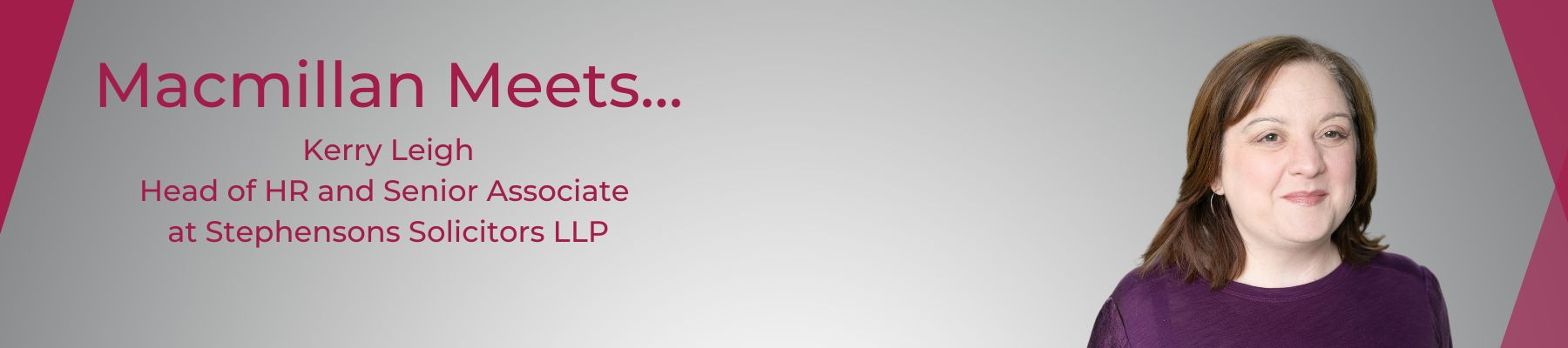
Macmillan Meets… Kerry Leigh, Head of HR and Senior Associate at Stephensons Solicitors LLP
Thu, January 15, 2026
In this edition of Macmillan meets, Macmillan Davies Senior Consultant Amy Mottershead sits down with Kerry Leigh, Head of HR and Senior Associate at Stephensons Solicitors LLP. Kerry shares her unconventional route into HR, the evolution of the profession, and how a people-first approach helped the firm secure a place on the Sunday Times Best Places to Work list.
Finding her way into HR
Kerry did not begin her career in HR. In fact, she discovered the profession later in life, after years of feeling unfulfilled in various roles.
“I came to HR quite late, almost 30, frustrated with the jobs I’d been doing. I’d done a bit of everything – call centres, waitressing, insurance claims, banking – and always did fine, but it never felt right.”
An online careers test recommending “personnel” introduced her to a path that immediately resonated.
“I’ve always loved structured, detailed work like contracts and employment law, but also working with people. My customer service experience helped me develop essential communication and people skills.”
While working in high street banking, Kerry began studying her CIPD Level 3 at night school. Encouraged by her tutor, she applied for an HR Assistant role at Stephensons and joined in 2004. The firm supported her development all the way to Level 7.
Around seven or eight years ago, during a review of the team, the business recognised the strategic importance of HR. Kerry stepped into the Head of HR role and was asked to build a function that added real value.
“I’ve now been at Stephensons for 21 years, and the last seven have been the most exciting yet.”
The best career advice she has ever received
Kerry reflects on two lessons that have shaped her leadership style.
“There are probably two main lessons I’ve learned.
The first is not to try to fix everything at once. Small changes can make a really big difference. You can’t fix everything at once, and not every change needs to be a big one. Sometimes the smaller steps have the biggest impact.
The second lesson is to always involve managers in your decisions. You can’t make a real impact without getting buy-in from others. We never make a major decision without involving our managers and employees.”
Stephensons now uses focus groups and committees to ensure people are involved from the outset.
“When people are involved from the start, they feel they’ve contributed and are more likely to take ownership, engage and help move it forward.”
Becoming a Sunday Times Best Place to Work
Kerry describes the firm’s journey to achieving the award as a return to authenticity.
“We tried for the Sunday Times Best Places to Work list before, but this time we succeeded by being true to ourselves, with a genuine identity, culture, and values. We focused on being flexible, supportive, caring, and authentic, going back to our grassroots.”
Despite having more than 300 employees, Stephensons has maintained a personable and supportive environment that allows people to balance real lives with work. Flexibility has been central to this.
The firm also supports employees across all life stages, offering initiatives such as financial advice, health benefits, enhanced family support, menopause leave, pregnancy loss support and fertility journeys.
Open and honest communication has been key too, with leaders hosting forums where employees can ask any question. Engagement through focus groups and committees strengthened ownership and gave the firm confidence to apply again.
“Winning created pride and belonging internally, helps with recruitment, and has opened more opportunities for me personally in the HR world. We plan to try again next year.”
What impact has the recognition had on the business so far
Although the award is still relatively recent, the positive effects are already visible.
There has been a noticeable boost to morale, with people talking about the achievement and feeling genuinely excited. The firm made a real celebration of the recognition, and the energy has carried through into day-to-day working life.
Increased visibility has been one of the clearest impacts. The Stephensons name is reaching more people – not only potential candidates but also those interested in working with the firm. The award has opened doors to new conversations with potential clients and referrers.
While it is still early to measure the full impact, early indicators are promising. Participation in this year’s internal engagement survey rose significantly, with very encouraging feedback.
“You can see it when you are in the office. There is a real buzz, a sense of energy and motivation among people.”
Kerry expects the recognition to continue strengthening relationships with clients, referrers and employees.
The skills HR leaders need today
Kerry highlights four essential capabilities for modern HR professionals.
“We have to be pretty resilient. Not everything is going to work, and not every initiative will deliver the results you hope for. Our HR team is small, only four of us, so we still have to manage the reactive, day-to-day HR work. We need the strength and resilience to say, okay, that didn’t work, but I can do this instead, or I’m going to try another approach.”
Creativity is also vital.
“We’ve had to be creative in how we engage with people and understand what they need. Surveys are becoming less effective, so we’ve had to find new ways of gathering information. Different departments behave differently, so one size doesn’t fit all.”
Strategic thinking is another requirement.
“HR professionals need to understand the challenges and objectives of the wider business and consider how we can influence those directions.”
And data capability is now fundamental.
“The challenge is not just collecting data, but understanding it and using it to inform next steps, translating data into actionable insights.”
The challenges shaping the HR landscape
Kerry highlights several external pressures that have influenced both the legal market and HR practice.
“The cost of living and budget pressures have had a huge impact. Faced with significant national insurance and minimum wage increases, so had to rethink our approach to benefits, improving what we already have without additional cost.”
Cost of living pressures have also shaped the recruitment market.
“Far fewer solicitors are actively looking for new roles, we focus on what else we can offer beyond salary.”
Compliance remains a dynamic challenge.
“The employment law environment is constantly evolving, and we must keep a close eye on changes and ensure compliance.”
The workforce itself is more diverse than ever.
“Our workforce spans four generations, so tailoring engagement, development and support is important. Mental well-being and neurodiversity are also actively addressed.”
The last few years have demanded exceptional adaptability.
“Since 2020, HR has faced unprecedented challenges. COVID, furloughing and rapid employment law changes required resilience, adaptability and toughness.”
How HR has changed and where it is heading
Kerry reflects on the evolution of HR over the past decade.
“Ten years ago, our HR team was very administrative and transactional, focused on compliance, paperwork, and procedures. While we did that well, we struggled to show the benefits and return of an internal HR team.”
This has shifted significantly.
“Over time, we’ve had to move beyond that and become more of a strategic partner, adding real value to the business, while still managing essentials like offer letters, contracts and terms.”
Investment in technology has been essential.
“About seven years ago, we upgraded from a simple database, and over the past two to three years, we’ve upgraded our entire HR tech suite. Automating administration has freed us to focus on strategic priorities.”
The focus of HR has expanded too.
“While compliance and reactive HR work remain, the emphasis has shifted to culture, engagement, well-being, embedding values and fostering inclusion.”
Looking ahead
“We must also consider changing employment law and technological advancements, including AI. HR needs to think strategically about how to harness AI to support employees, engagement and business success.
HR will continue to evolve as a strategic partner, balancing compliance with employee experience, and embracing technology and AI.”
Final thoughts
Kerry’s journey highlights how HR has transformed from a transactional function into a strategic driver of culture and organisational performance. Stephensons’ recognition as a Sunday Times Best Place to Work demonstrates what can be achieved through authenticity, openness and long-term investment in people.
Get in touch
If you would like to discuss the above, be featured in ournext Macmillan Meets article, or your search for work/recruiting into your team please contact Amy Mottershead directly at amottershead@mdhr.co.uk
To ensure you don’t miss any updates from Macmillan Davies and to hear about our latest events click here to sign up to subscribe to our updates.