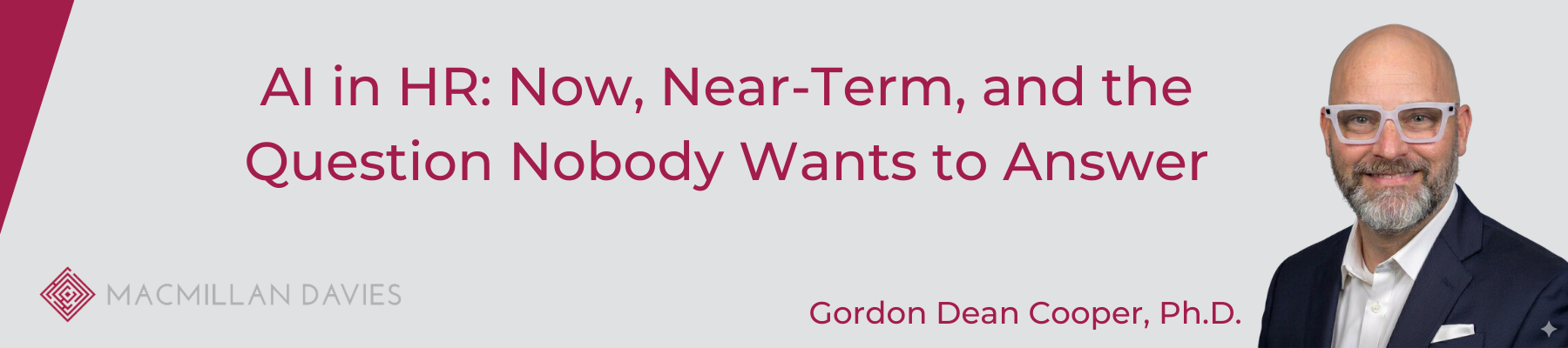
AI in HR: Now, Near-Term, and the Question Nobody Wants to Answer
Sun, May 31, 2026
AI in HR: Now, Near‑Term, and the Question Nobody Wants to Answer
Most HR teams will tell you they’re “using AI.” Scratch the surface and it’s usually a chatbot tidying up emails. That’s not transformation. That’s admin.
I recently sat down with New York–based CPO Gordon Dean Cooper to talk about AI and HR across three horizons:
Exec bio: Gordon Dean Cooper, Ph.D.
Gordon Dean Cooper is a senior human resources executive with a career built on a single conviction: HR is not a support function, but a core driver of business performance. He has held global senior people leadership roles at LVMH, JP Morgan Chase, MasterCard, and Deloitte Consulting. Gordon holds a Ph.D. in Clinical Psychology and an M.A. in Industrial/Organizational Psychology from the University of Tulsa, and a B.S. from the University of Florida (Go Gators). A sought-after voice on the future of HR, HR transformation, and organizational performance, he writes and speaks on a question the profession can no longer avoid: what separates HR that drives business performance from HR that merely supports it.
- What’s already possible now
- What changes in the next 2–5 years
- The uncomfortable long‑term question about HR careers
It was candid, practical and refreshingly free from hype. Here’s what stayed with me.
NOW: AI as your daily co‑pilot
The real value of AI in HR isn’t drafting emails. It’s compressing strategic work that used to take weeks.
- Scanning thousands of performance reviews to surface development themes and skills gaps
- Mapping succession risks across 50–100 leaders in minutes, not months
- Running comp analysis on anonymised data to identify band overlap and fairness issues
On my side, market research that once took a full day now takes five minutes. Shortlisting tools can rank an entire market against a brief, with me deciding when to override the machine.
If your HR team is treating AI as a novelty rather than a daily co‑pilot, you’re already behind.
MID‑TERM: 500‑person companies acting like 5,000‑person companies
Gordon’s framing stood out. AI turns capable generalists into people with a virtual bench of world‑class specialists.
A CPO without a dedicated comp centre of excellence can still produce a credible first‑pass bands proposal. A recruiter can have AI scan a whole market and prioritise outreach, freeing their time for real conversations rather than research.
This isn’t about 10–20% efficiency gains. It’s about fundamentally different capability at the same headcount.
For HR leaders, this demands AI literacy, not just AI awareness. It means knowing how people actually spend their time in each role and asking the hard question: why are we still doing this manually?
LONG‑TERM: The K‑shaped outcome for HR
The long‑term view was less comfortable.
Gordon doesn’t believe everyone keeps their role and simply becomes more efficient. He expects back‑office, process‑heavy HR roles to shrink, with some capacity reinvested into sales and product rather than redeployed one‑for‑one into new HR work.
Together, we see a K‑shaped outcome:
- Upwards: a group of people leaders who ride the wave, architect AI‑native organisations and own ethics and governance
- Downwards: another group whose work becomes increasingly automated and fragmented
The real question isn’t whether to use AI. It’s whether you’re building towards the top of the K or the bottom.
What to do with this today
When I interview senior HR talent now, I ask three questions:
- What did you build or change with AI?
- How did you manage governance?
- What changed in the business because of it?
If there’s no real outcome, it’s experimentation theatre.
Closing thoughts
Over the coming weeks, I’ll be sharing short clips from my conversation with Gordon, including where we disagreed and what it means for CPO careers in New York and beyond.
If you’re a CEO or CPO in FS or fintech grappling with these questions, I’m always happy to compare notes off the record.