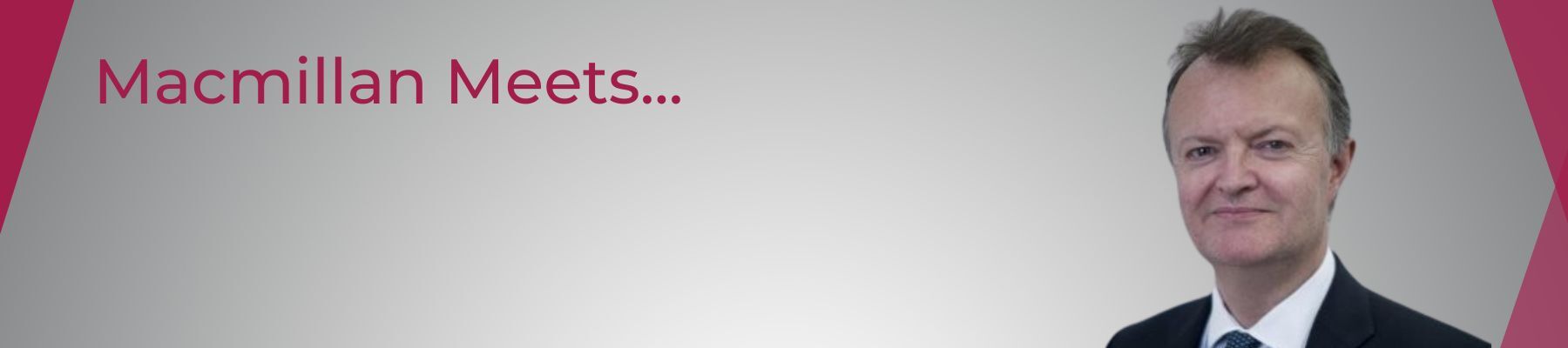
Macmillan Meets… Craig McCoy, chair of the HR Connection Group
Thu, August 14, 2025
In this edition of Macmillan Meets, Macmillan Davies Managing Director Darren Hayman sits down with Craig McCoy, recently named one of HR Magazine’s Most Influential, to discuss his remarkable 41-year career in HR, his move from permanent leadership roles into interim assignments, and the growth of one of the UK’s most active HR networks.
Craig’s career has spanned sectors from tech and media to healthcare, with more than 6 permanent and 15 interim CPO and HRD assignments under his belt. We have also shared the judging table at the Personnel Today Awards, so I was looking forward to revisiting some of those experiences and hearing more about his latest recognition.
You’ve had a long and varied career – can you take us through it?
It’s been 41 years in the HR profession, man and boy. I started straight from university, my degree was in French and Italian, and I decided I didn’t want to be an academic or a teacher. My first job was as a training officer in local government, so I began in learning and development, which I did for the first six years.
I moved into the City with Datastream, now part of Thomson Reuters, then into Accenture (then Andersen Consulting) as a consultant working with clients like Barclays and North West Water. After a year of living out of a suitcase, my old boss tempted me back to Datastream, this time as HR director at just 32.
From there, I went to Compaq as HR director for the UK and Ireland, and then on to my biggest job on paper: group HR director at Sky. They were already in the FTSE Top 20, but I was their first group HRD. I then spent time at BT before moving to Aegis Media (Dentsu) as HR director for Europe, the Middle East and Africa, which I’d say was my favourite job.
“At the top level, your HR skillset is a given. What matters is your ability to influence and add value to the business.”
What made Aegis (Dentsu) your favourite role?
I loved working in the international advertising industry. I was responsible for about 45 countries and 8,000 people, during a period when digital advertising was exploding. We were acquiring 40 to 50 agencies a year, folding them into the group but letting them keep a degree of autonomy.
The personalities were fascinating, big characters, incredibly creative, sometimes prima donnas. It wasn’t an environment where job evaluation or rigid HR processes got much traction; it was all about talent and individuals. I also got to dust off my languages and spent a lot of time in France, where I’d speak French, even if they insisted on speaking English back.
It was challenging and stimulating, integrating new talent without suffocating it, and it taught me a huge amount about balancing corporate strategy with local culture.
What came next?
I left Aegis during the recession and did a couple of interim roles before joining Bupa as HR director for Bupa Health Insurance. After three years there, at 53, I decided I wouldn’t look for another permanent job.
Why make the switch to interim?
By that point I’d had 30 years in permanent roles, so I’d “been there, done it”. I liked the idea of being dropped into new situations and having to find my feet quickly. The work was mentally stimulating, I could focus on making an impact, and I enjoyed the variety.
Since then, I’ve done over 15 interim assignments, mostly as CPO or HRD and mostly in healthcare, though I’ve never worked for the NHS. It’s been a mix of day-rate and fixed-term contracts. I’m contract agnostic; for me, the work and the people matter more than the label.
You also run the HR Connection Group. How did that happen?
The London HR Connection started in the 1980s under the CIPD as a special interest group. It had a commercial sponsorship model, which was unusual for the branch network. After 40 years and 5,000 members, the CIPD decided they no longer wished to support it.
They asked what we wanted to do, and I decided to take it on as my own business in July 2024. It’s still run as a not-for-profit, and most of the volunteer board stayed on. Since then, we’ve tripled the number of events, expanded nationally, and diversified formats, from 100-person evening events to private dinners and breakfasts and small roundtables.
We’ve also launched specialist groups, like the Reward Connection, and are considering talent acquisition and internal comms. The network now reaches beyond London, with events in Manchester, Newcastle and Cardiff. The aim is always to blend strong, relevant content with great networking, and to create opportunities for sponsors and senior HR leaders to connect in a meaningful way.
“We’ve tripled the number of events and taken the network national. It’s thriving and evolving.”
You’ve worked across very different sectors. Are HR skills really transferable?
Yes, but at a senior level, your HR skillset is almost assumed. The differentiator is your commercial understanding and how you contribute to the leadership of the business.
It’s about having an opinion on non-people matters, adding value to commercial decisions, and taking ownership beyond the HR remit. That’s why hiring managers often prefer someone from the same sector — they can hit the ground running on the business context. But with the right mindset and curiosity, you can absolutely make the switch.
We’ve both judged the Personnel Today Awards – what’s that experience like for you?
It’s a privilege, and it’s fascinating to see such a range of entries from organisations you might never havecome across previously. Like you, I enjoy spotting the ones that really stand out, innovative, commercially aligned, and making a measurable difference to the business, not just HR.
You can tell when real thought and effort have gone into telling the story. Those are the ones that stick in your mind and get the higher scores.
What advice would you give to aspiring HR leaders?
Get experience outside HR. Work in operations, marketing, consulting, anything that broadens your commercial perspective. Some of the best HR people I’ve hired had careers that weren’t purely linear.
And take accountability. Too many HR leaders position themselves as advisors only. Sometimes you have to own the decision and its outcome.
What’s surprised you most in your career?
How much of the job is about managing the dynamics at the top. As HRD, you see all the strengths and weaknesses of the leadership team up close. Being a wise counsel, reading situations, and stepping in at the right moment, those interpersonal skills often matter more than any technical HR knowledge.
“The value you bring isn’t in knowing every policy detail. It’s in managing sensitive situations and taking accountability.”
You were recently recognised as one of HR’s Most Influential – what does that mean to you?
It’s an honour. It’s recognition from peers across the profession, and it reflects the relationships and work I’ve built over the years.
If you could change one thing in UK workplaces tomorrow, what would it be?
Truly flexible working, where people can choose how, where and when they work. COVID proved it’s possible, and we should build on that.
It was a pleasure for Darren Hayman to revisit Craig McCoy’s career highlights, strategic insights, and dedication to connecting HR professionals. You can find Craig on LinkedIn or join one of the HR Connection Group’s upcoming events to meet him in person.
(see www.londonhr.org for more details and how to join)