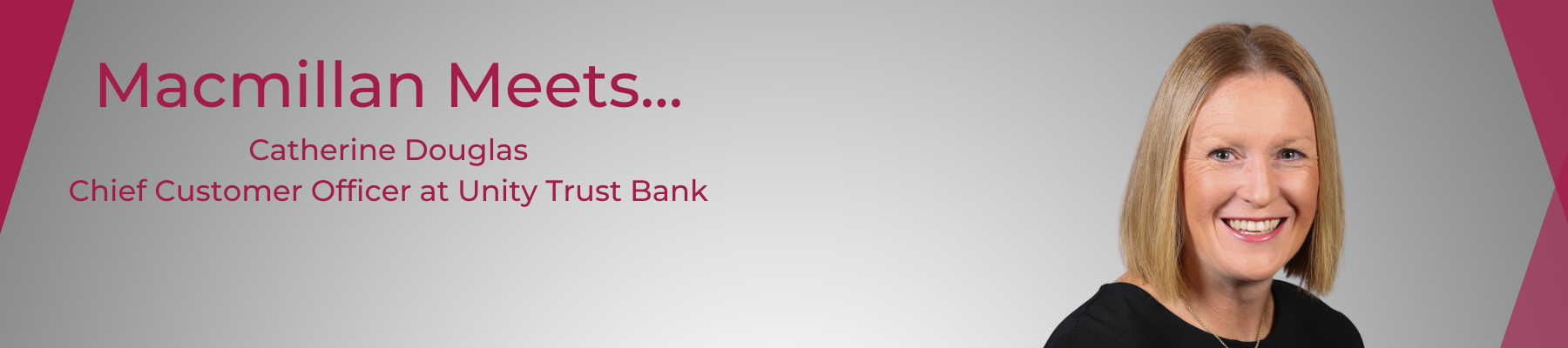
Macmillan Meets… Catherine Douglas, Chief Customer Officer at Unity Trust Bank
Thu, March 19, 2026
Macmillan Meets… Catherine Douglas, Chief Customer Officer at Unity Trust Bank.
In our latest edition of Macmillan Meets, Leanne Boddy, Associate Director at Macmillan Davies talks to Catherine Douglas, Chief Customer Officer at Unity Trust Bank, whose career spans high-street retail, business banking, and People & Culture leadership. She reflects on her earlier pivot into HR/People as Chief People & Sustainability Officer at The Co-operative Bank and shares what drew her to multigenerational workforce dynamics.
Tell us about your career to date, including the pivot into People & Culture
I started my career many moons ago in fashion retail. I got a graduate role at what was then the Burton Group, working across brands like Debenhams, Dorothy Perkins, Principles, Topshop, Topman. Running stores felt like running your own business, you had responsibility for everything, from profit and loss to staff development. It was a brilliant grounding in general management.
From there I moved to other retailers, including Littlewoods, where I managed multiple stores and eventually a region. That was great experience in leadership and operational management, but I was ready for a new challenge.
So I pivoted into financial services, first with HBOS, then Santander. At Santander, I moved into business banking and eventually became a Regional Director, helping to grow the team from 15 local business managers to around 350 nationally. That led to my first head office role as Commercial Director, working across marketing, product, risk, and learning & development. Later at TSB, I took on a broader remit covering strategy, performance, and business banking. That was right through COVID, so delivering financial support schemes was intense but incredibly rewarding.
Then I joined The Co-operative Bank to lead a big business banking investment. We launched new products, a mobile app, and digital services. It was during that period that my pivot into People became formal, I took on the role of Chief People & Sustainability Officer. I was really drawn to it because I’ve always had a passion for people. For me, success is about the team you work with, developing people, coaching them, and making sure everyone’s strengths are brought to the fore. I loved creating our first people strategy, working from bottom to top to understand what colleagues needed. That role was broad, I also oversaw marketing, communications, and facilities, so no two days were the same.
After helping deliver profitability and a successful sale of The Co-operative Bank, I decided it was time for a new challenge. That’s when I moved to Unity Trust Bank.
What first sparked your interest in generational dynamics at work?
I’ve always been interested in it, even before formally leading People. At The Co-operative Bank, we had a great graduate scheme and internship program, but nothing for degree apprenticeships or summer internships. I was keen to explore that, making sure we weren’t just recruiting from certain universities, but focusing on skills and potential.
Once I was in the Chief People role, I really got into strategy and realised the workforce was changing. For the first time, we had up to five generations working together, with different expectations around flexibility, learning, wellbeing, and development. That really sparked my thinking about how we can make policies and work practices inclusive across all these groups.
What are the biggest misconceptions about different generations in the workplace?
I think organisations often go too broad and assume one size fits all. People talk about “generational clashes,” but it’s not really like that. Yes, younger colleagues may prefer different ways of working, and older colleagues have valuable experience and knowledge, but there’s a huge opportunity when you bring those together.
Some people assume younger generations are entitled or don’t want to work hard. Others think older generations are resistant to change or technology. There are elements of that, sure, but it’s not true across the board. What really works is understanding strengths, facilitating collaboration, and being flexible, whether that’s around communication, hybrid working, or benefits.
What defines a truly inclusive, multigenerational culture?
It’s about recognising that one way doesn’t fit everyone. Different people need different approaches. Some like face-to-face meetings, others want quick, snappy digital communication. Some need flexible hours because of caring responsibilities, others want opportunities for career development or part-time roles as they approach retirement.
It’s also about creating opportunities for cross-generational collaboration, getting different perspectives in the room. That’s where real innovation comes from. And transparency is key. You need to listen, understand, and be honest about what’s possible.
Looking ahead: what trends will shape the workforce over the next five years?
AI is a big one, it will take over mundane tasks, freeing people to focus on higher-value work. Leadership will need to evolve too, managing diverse teams, recruiting for skills rather than tenure, and supporting flexible working will be essential.
I also see younger generations approaching work differently. They value purpose, flexibility, and entrepreneurial thinking. Careers won’t follow a straight path; there will be more project-based and portfolio working. As leaders, we need to adapt to that and ensure people across all generations feel valued and supported.
What’s the best piece of career advice you’ve received or would give?
Be yourself. Stay true to your values. Don’t try to be what you think someone else wants you to be. If you compromise your values, you’ll find yourself in situations that aren’t enjoyable. But if you stick to who you are, you’ll be successful and genuinely fulfilled.
Tell us about your new role at Unity Trust Bank
I joined Unity Trust Bank about seven months ago as Chief Customer Officer. It’s a smaller, specialised business bank supporting business customers across the UK. My role is really focused on the customer, understanding their needs, and developing products and services that help them grow and succeed.
We’re a small team, about 300 colleagues, but we’re ambitious and growing quickly. It’s great to be back out in the business space, meeting clients, attending events, and helping shape propositions that really make a difference for our customers.
Get in touch
If you would like to discuss this article, be featured in a future Macmillan Meets interview, or talk about your search for work or recruitment needs, please contact Leanne Boddy directly at lboddy@mdhr.co.uk or connect with her on LinkedIn. To ensure you don’t miss updates from Macmillan Davies or hear about our latest events,
https://www.mdh.co.uk/email-co....