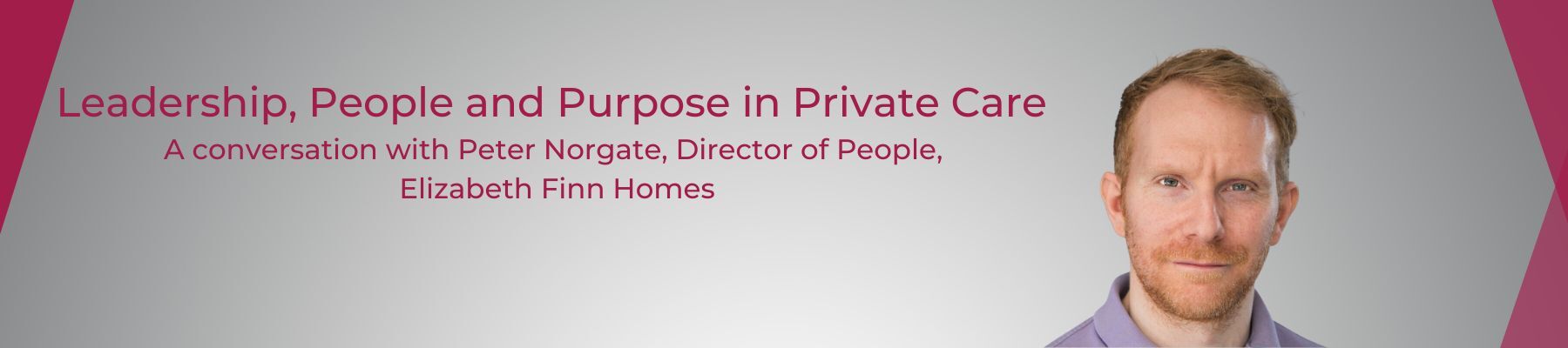
Leadership, People and Purpose in Private Care - A conversation with Peter Norgate, Director of People, Elizabeth Finn Homes
Thu, February 19, 2026
In this interview, we speak with Peter Norgate, Director of People at Elizabeth Finn Homes, about what it really takes to lead people effectively in private care. Peter shares candid insight on recruitment pressures, agency spend, supporting home managers, and why values-led leadership is a genuine competitive advantage in this sector.
Leadership, people and purpose in private care
The private care sector sits at the intersection of some of the UK’s most complex challenges: an ageing population, increasing regulatory scrutiny, persistent skills shortages, and rising expectations around quality, dignity and experience.
In a recent conversation, Peter Norgate, Director of People at Elizabeth Finn Homes, shared candid insights into what it really takes to lead people effectively in care, and why many assumptions about the sector miss the point.
From charity to private care without losing purpose
Peter’s move from the charity sector into private care wasn’t a rejection of purpose. If anything, it sharpened it.
“Elizabeth Finn Homes is a for-profit business, but we’re wholly owned by a charity and 100% of our profits are used to fund their work. So while I’ve moved out of the charity sector in the purest form, we’re still very much connected to a charitable purpose, and that’s important to me.”
That duality of commercial discipline combined with social purpose has shaped how Peter approaches leadership.
“You’re opened up to more commercial thinking and metrics, but it’s still for a purpose. It’s not just about generating profit. People are at the centre, it’s about the experience of residents.”
Recruitment challenges: why care is different
Unlike many sectors that have swung back towards employer-led hiring, care remains firmly candidate-led.
“The care sector bucks the wider trend. It can actually be more employee-led, particularly for people with health, social care or nursing backgrounds.”
Some roles remain especially hard to fill.
“Home managers are probably the hardest roles to recruit for, and it really depends on geography. Oxfordshire, for example, is incredibly competitive because of the density of care homes.”
But technical competence alone isn’t enough.
“You’re trying to attract people who can not only do the role, but who also match your culture, values and behaviours. That’s what makes it challenging.”
The hidden cost pressure leaders don’t talk about enough
Agency spend remains one of the biggest operational risks in care.
“You could have great occupancy, but if you’re backfilling with lots of agency, it can erode your margin incredibly quickly.”
Reducing reliance on agency staff isn’t just about cost control, it’s about relationships.
“Having strong relationships at the home manager level is absolutely key. Knowing your team, understanding what works for their lives, and building a reliable internal bank makes a huge difference.”
Supporting home managers under constant pressure
Home managers carry extraordinary responsibility, operational, emotional and legal.
“They are legally responsible for the home. There’s a lot resting on them.”
Elizabeth Finn’s approach focuses on layered support.
“It’s about having a peer network, strong operational leadership, and a central people team that can support specialist areas.”
But just as important is protecting well-being.
“Making sure they can take annual leave, switch off, and know the home will be safe, that makes a big difference. This is a marathon, not a sprint.”
Values as a competitive advantage
When asked what Elizabeth Finn does particularly well, Peter didn’t hesitate.
“Our values come up time and time again in interviews, from junior roles right through to senior leaders.”
Those values aren’t slogans. Bring love, welcome all, inspire more and act with purpose were the four values developed collaboratively with residents and employees at all levels of the business.
“They’re not just words, they’re calls to action. And they sit in our supervisions, appraisals and competencies. We talk not just about what we do, but how we do it.”
And that consistency matters.
“It doesn’t matter if you’re a carer, a gardener, maintenance, or central team, those values run through everything.”
Small changes, big impact
One of the most effective changes Peter introduced wasn’t complex, it was visual clarity.
“We had no organisational dashboard. No simple way of seeing how our eight homes were performing.”
The solution?
“One page. Three areas, people, quality and commerciality, with simple RAG ratings. It immediately showed us where to focus.”
The impact was disproportionate.
“It allowed senior leaders to spend time where it really mattered, instead of working out where the problems were.”
What the future holds for care providers
Looking ahead, Peter sees employment regulation as one of the biggest shifts.
“Everything connected to the employee will matter, particularly with the Employee Rights Act and changes to sick pay and fair pay agreements.”
But he also sees opportunity.
“Care is a people-hungry industry. Technology and AI can help, but it will never replace the human element.”
And perhaps the biggest misunderstanding?
“People don’t realise you can have a real career in care, from entry-level roles right through to senior leadership.”
Final reflection
For Peter, leadership in care is ultimately about clarity, empathy and realism.
“There are no easy jobs in care. Every role matters. And making people feel seen and heard, that’s what makes the difference.”
As the sector continues to evolve, voices like Peter’s offer a grounded reminder: sustainable care starts with sustainable people leadership.
Get in touch
If you would like to discuss the above, be featured in our next Macmillan Meets article, or your search for work or recruiting into your team, please contact Ant Coen directly at acoen@mdhr.co.uk or connect with him on LinkedIn.
To ensure you don’t miss any updates from Macmillan Davies and to hear about our latest events click here to sign up to subscribe to our updates.