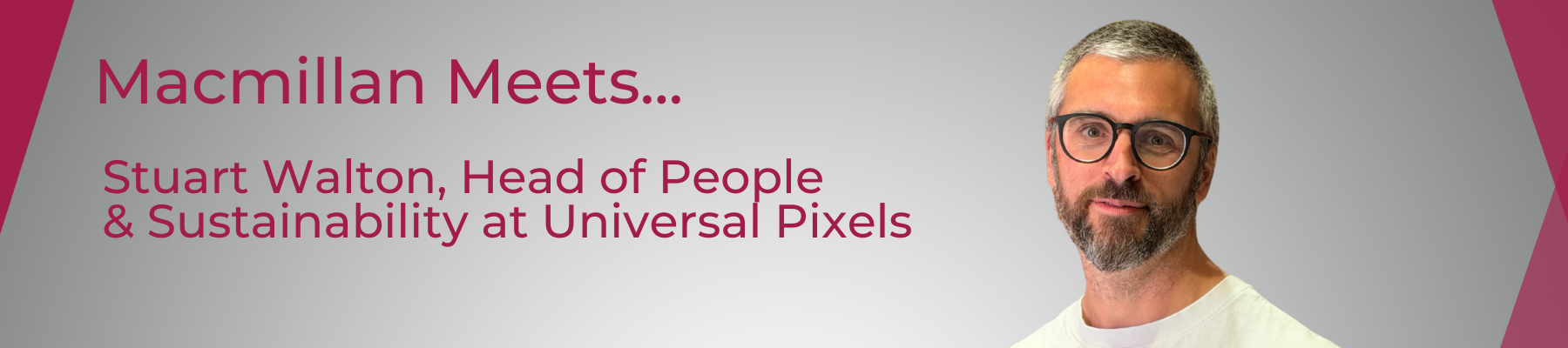
Macmillan Meets…Stuart Walton, Head of People & Sustainability at Universal Pixels
Tue, April 14, 2026
In this edition of Macmillan Meets, Anthony Coen sits down with Stuart Walton, Head of People & Sustainability at Universal Pixels. Stuart shares his non-linear route into people leadership, how his dual role across people and sustainability has shaped his thinking, and why the future of the profession will depend on stronger commerciality, better use of technology and a clearer focus on business value.
A non-traditional route into people leadership
Stuart’s route into people leadership has been far from conventional. He began his career in banking, where he spent a decade building commercial, sales and relationship management experience before stepping away to pursue a passion for fitness.
That move led him to build a personal training business, which evolved into broader coaching work across performance, mindset and leadership. During that time, he worked with high-performing individuals in demanding environments, including as part of the team supporting Jason Momoa’s preparation for Aquaman.
“High performance rarely happens by accident.”
For Stuart, those experiences reinforced lessons that continue to shape his leadership thinking today: the importance of clarity, discipline, trust, and helping people perform at their best under pressure.
His move into HR came through reflection on where his strengths — coaching, understanding people and driving outcomes — could add the most value in a business context. While his career path may look non-linear on paper, Stuart sees clear golden threads running through it: a consistent focus on people, a coaching-led approach to development, and a drive to create both personal and commercial value.
For Stuart, the journey reinforced a simple but powerful idea: careers do not need to be linear, but they do need to be intentional.
People, sustainability and business leadership
Now sitting across both people and sustainability, Stuart has developed a broader view of what leadership requires.
For him, sustainability is not just an environmental issue. It is about building a business that can perform and endure over time. That perspective has strengthened his belief that people strategy and sustainability are far more connected than they are often treated.
Both rely on leadership choices, behaviour change, stakeholder alignment and long-term thinking. Both also require leaders to look beyond short-term delivery and consider what will help a business stay healthy, relevant and resilient in the future.
The dual role has reinforced a leadership mindset that goes beyond functional expertise. Stuart believes leaders need to understand the wider business, think beyond their own discipline, and balance short-term results with long-term value creation.
Behind the scenes at Universal Pixels
Stuart is Head of People & Sustainability at Universal Pixels, a growing specialist in video and visual display technology across live music touring, film, TV and theatre.
The business plays a key role behind the scenes in major productions, helping deliver the visual experiences audiences see on large-scale LED screens and other immersive environments.
A key recent milestone has been achieving B Corp certification, reflecting Universal Pixels’ commitment to responsible business practices, long-term sustainability and creating positive impact beyond profit.
Stuart also highlights a culture with a strong focus on internal growth and opportunity, a willingness to create roles around people’s strengths, and a real commitment to building future capability rather than focusing only on current performance.
Building credibility and influence
When it comes to building credibility at senior level, Stuart is clear that HR expertise alone is not enough.
For him, credibility comes from understanding the wider business and contributing to it in a meaningful way. That starts with commercial fluency: understanding financial and operational drivers, speaking the right language with different stakeholders, and forming views grounded in data, judgement and experience.
He also believes influence requires confidence to contribute beyond the traditional HR remit. At the same time, softer qualities matter too.
Curiosity, humility and a willingness to admit when you are wrong all play an important role in building trust and strengthening relationships at leadership level.
Ultimately, Stuart sees influence as coming from relevance — connecting people insight directly to business priorities and outcomes.
What growing businesses often underestimate
In fast-growing businesses, Stuart believes the biggest people challenges are often not the most complex ones, but the most foundational.
Growth exposes weaknesses that may have been manageable at a smaller scale: management inconsistency, uneven employee experiences, people being promoted without the right support, and a lack of structure in areas that have grown quickly.
He also sees a tendency for businesses to become too reactive — hiring only when pressure is already present, addressing engagement issues too late, or failing to build future capability in advance.
For Stuart, one of the biggest balancing acts is delivering what pays the bills today while still planning for what will sustain the business tomorrow.
What real value creation looks like in people leadership
A recurring theme in Stuart’s thinking is the need to move beyond reporting metrics and towards explaining impact.
He uses a simple question to test whether something really matters.
“So what?”
An engagement score may improve or productivity may increase, but the real value lies in what those changes enable — better performance, stronger retention, smoother growth and more effective change.
For Stuart, real value creation means translating people data into commercial outcomes and communicating impact in a way stakeholders understand.
This shows up in areas such as retaining critical talent, strengthening management capability, improving succession depth and reducing friction across the organisation.
The next chapter for the people profession
Looking ahead, Stuart sees AI as one of the defining themes for the future of the profession.
He describes two dimensions: AI within HR, including automation, hiring and workflows, and AI across the wider workforce as part of workforce planning and operating model design.
In his view, AI should be treated as part of the workforce — a form of digital headcount to consider alongside human capability.
This creates an opportunity for People leaders to support adoption, shape governance, manage workforce transition and drive value through better-designed organisations.
More broadly, Stuart believes the profession must continue improving how it responds to challenge and criticism by becoming more commercial, more focused and clearer about the value it creates.
AI, change and the human response
Stuart also challenges the idea that resistance to AI is mainly generational.
Instead, he sees it as a human response to change. Some will embrace it, some will resist it, and most sit somewhere in the middle.
That is why effective change leadership is critical. For Stuart, this means meeting people where they are, clearly communicating the value of change, explaining what is in it for them, and supporting reskilling and redeployment where needed.
Change is rarely straightforward, but with the right approach it can still be inclusive, practical and effective.
Final thoughts
Across the conversation, one theme comes through clearly: people leadership continues to evolve from a support function into a strategic driver of business value.
Whether the focus is sustainability, AI or the challenges that come with growth, expectations are rising. People leaders need to think commercially, act strategically, communicate impact and keep improving.
For Stuart, the opportunity is not just to support the business, but to help shape what it becomes.